The Formation of てforms
The Formation of てforms
Before studying てforms, please review how to classify verbs as it is important in being able to successfully conjugate the verb correctly.
てform is a very important form and it's used for more grammar points in future lessons so it is important to get a good understanding of it.
A) 2nd and 3rd groups
We will start with the 2nd and 3rd groups as their conjugation is very straightforward.
You just need to substitute 「て」 for 「ます」for both groups:
たべます ⇒ たべて
みます ⇒ みて
します ⇒ して
きます ⇒ きて
B) 1st group
There are 9 types of 1st group verbs based on the verb ending sound [k,g,s,t,m,n,b,r,w]. 「かいます」has apparently no consonants, but [w] underlies and [w] disappears since [wi] does not exist in Japanese. In てforms some of these 9 types of verbs are merged, there are only 5 types of conjugation of てforms.
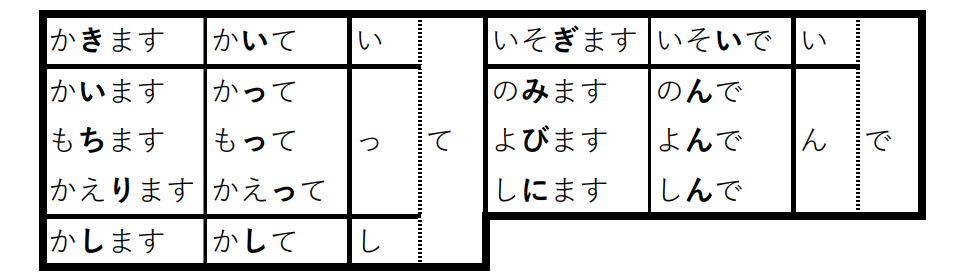
1) The same conjugation rule applied to 2nd and 3rd group verbs is applicable to shi verbs「かします/かして」
2) ki/gi verbs「Xきます/Xぎます」 are formed into 「Xいて/Xいで」 respectively. As you can see in the table, 「て/で」is perfectly predictable by 「ます」forms: with two dots in ますform, then also 2 dots in てform.
3) The remaining 3 groups / 6 verb cases are divided into only two types as the result of the merger.
[(w)i ti(chi) ri] conjugate to 「って」,
[mi, bi, ni] conjugate to 「んで」.
In these cases, っ is always followed by て, while ん is followed by で.
We recommend memorizing [mi bi ni] at first, because the total number of [mi bi ni] is smaller and there is only one [ni] verb,「死にます」"to die".
4) The only exception to the above rules is 「いきます」. 「いって」 is used instead of 「いいて」
Some Remarks for Further Study
Even if you memorize the formation rules, several weeks may be necessary for you to manage てforms. Here are some tips.
1) Confusion due to grouping error
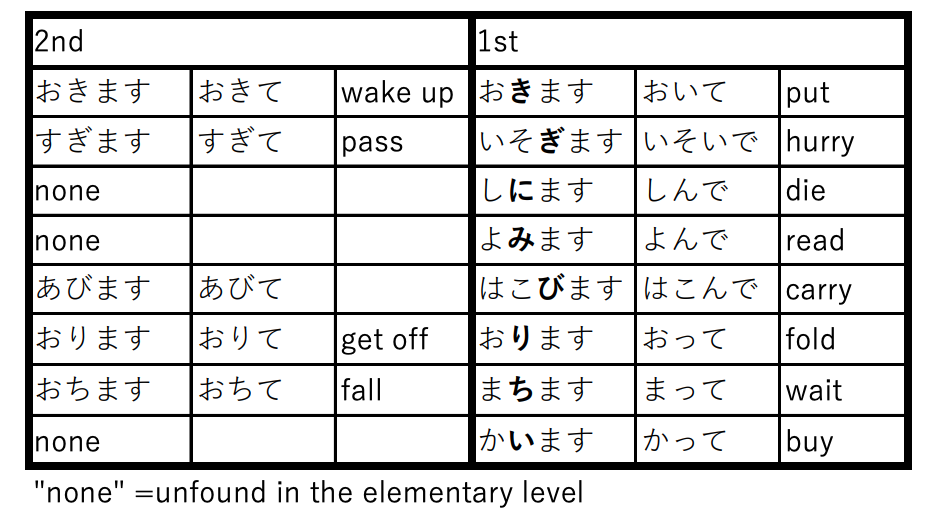
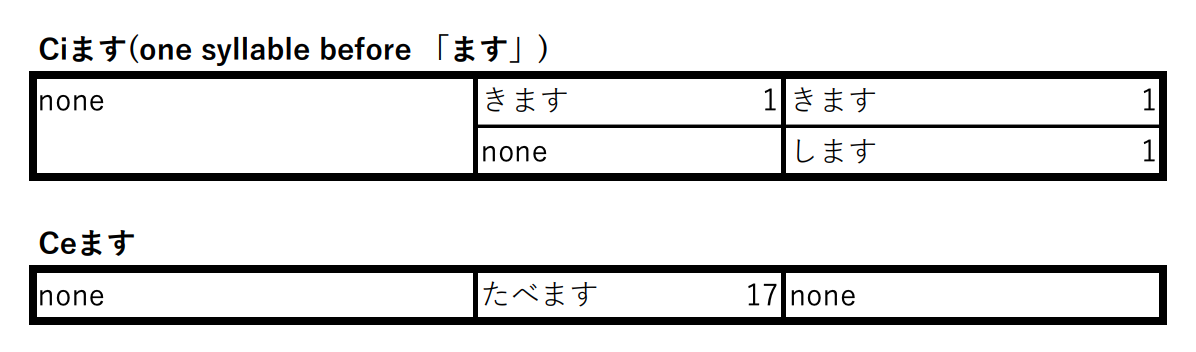
As explained already in the section of the grouping of the verbs, it is only 「XCiます」(cases where more than two syllables before 「ます」 and the preceding vowel is [i]) that it can not be grouped to 1st or 2nd automatically. Then we illustrate some examples of both 1st and 2nd group verbs.
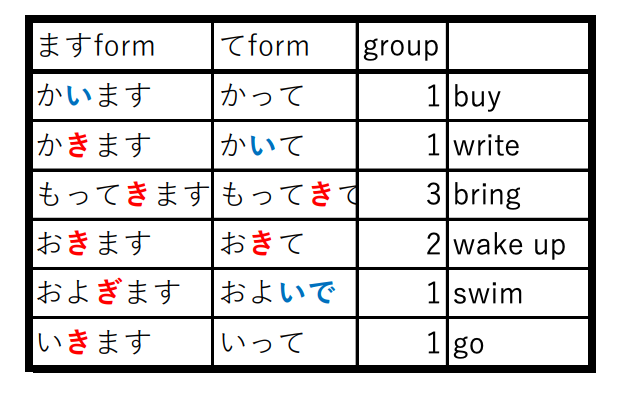
2) Other confusing ones
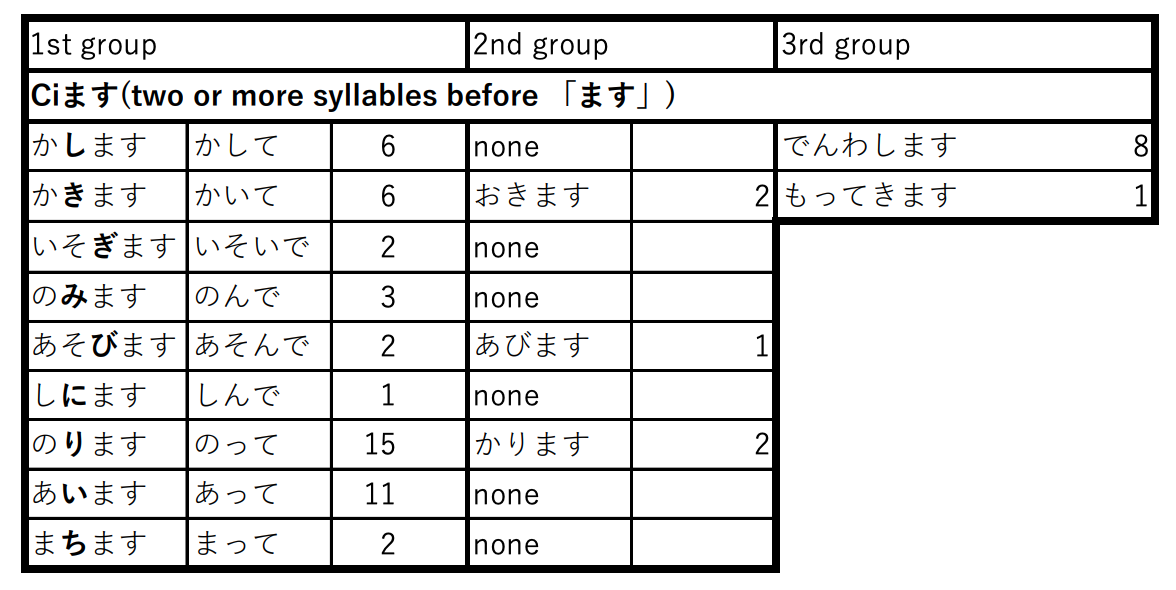
3) Table of the number of verbs
You may wonder which type is dominant and which type is exceptional. We show the number of each type of verbs which appear up to D30.
You can download this cheat sheet here,